



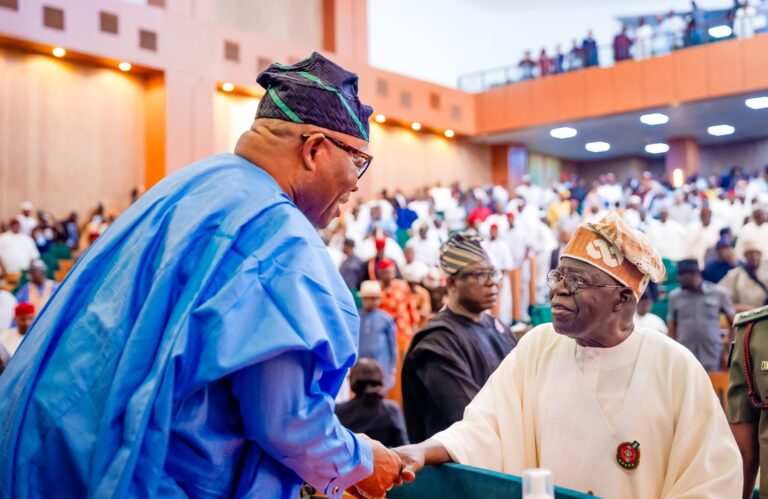
Senate President Godswill Akpabio has appealed to President Bola Ahmed Tinubu to reconsider the recent directive withdrawing police officers assigned to Very Important Persons, warning that the move could expose lawmakers to serious security risks.
Akpabio made the appeal on Friday at the National Assembly complex in Abuja while addressing a joint session of lawmakers ahead of the presentation of the 2026 Appropriation Bill by the President.
While welcoming Tinubu and reaffirming the legislature’s support for his administration, the Senate President acknowledged the challenges and reforms undertaken over the past year. However, he raised concerns about the immediate impact of the police withdrawal policy on members of the National Assembly.
According to Akpabio, some senators had expressed fears that returning to their constituencies without police protection could put their lives at risk.
He noted that lawmakers share in both the sacrifices and achievements of the current administration but urged the President to review the directive in the interest of safety.
The appeal followed President Tinubu’s earlier order directing the redeployment of police officers attached to VIPs nationwide, with the aim of strengthening frontline policing duties.
Confirming the development, the Inspector-General of Police announced that 11,566 officers previously assigned to VIP protection had been withdrawn and reassigned to core security operations across the country.
The plea came on the same day President Tinubu presented a ₦58.18 trillion 2026 budget proposal to the National Assembly. The President described the spending plan as a critical step toward fiscal discipline, economic consolidation, and improved governance.
Tagged the “Budget of Consolidation, Renewed Resilience and Shared Prosperity,” the proposal seeks to build on recent economic reforms and convert macroeconomic gains into tangible improvements in citizens’ living conditions.
Tinubu also announced an end to the long-standing practice of overlapping budgets, stating that all outstanding capital obligations from previous years would be fully settled by March 31, 2026.
He explained that Nigeria would thereafter operate a single annual budget tied to one revenue cycle, a move aimed at eliminating abandoned projects, repeated rollovers, and inefficiencies in public spending.
The President described the new approach as a decisive reset intended to strengthen accountability and restore confidence in the country’s budgeting process.
- Latest
- Trending

