



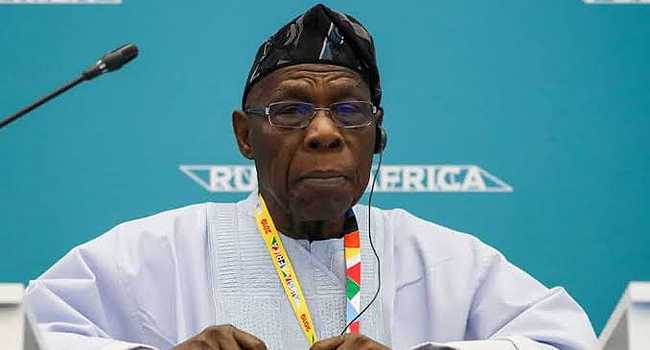
Former President Olusegun Obasanjo has criticised Nigeria’s handling of its prolonged security crisis, arguing that the country’s 15-year battle against Boko Haram has been unnecessarily extended because insecurity has evolved into a lucrative enterprise for certain actors.
Speaking during the Toyin Falola Interviews on Sunday, Obasanjo expressed concern that the insurgency has now endured far longer than the Nigerian Civil War, despite massive national spending on defence and counter-terrorism.
The discussion also featured Bishop Matthew Kukah of the Catholic Diocese of Sokoto and former Central Bank Deputy Governor Kingsley Moghalu, who joined in assessing Nigeria’s deteriorating security situation.
Obasanjo stated that successive governments have failed to adopt the correct mix of modern counterinsurgency strategies—such as specialised training, advanced intelligence systems, technology-driven surveillance, and appropriate equipment. He stressed that traditional military tactics alone cannot defeat a mobile and deeply embedded terrorist network.
“The military is trained for conventional battle,” Obasanjo said. “But when you are dealing with fighters who mix with civilians or constantly move, you need a completely different approach. Countries like Colombia have done this successfully. There is no shame in learning from them.”
He further alleged that elements within Nigeria’s security framework may be benefiting from the prolonged conflict, describing the situation as an organised structure rather than a mere failure of operations.
“It has become an industry,” he said. “When the military is the one procuring equipment, something is fundamentally wrong. Training, equipment, intelligence, and technology must work together.”
Obasanjo warned that Nigeria’s efforts will continue to fall short if international partners remain hesitant to share critical intelligence due to repeated leaks and infiltration within security agencies.
Reflecting on a 2011 backchannel effort, he revealed that Boko Haram initially refused dialogue but later accepted a 21-day ceasefire to enable negotiations—a window the Nigerian government failed to utilise.
“They agreed to a 21-day ceasefire for talks, but the government did not engage them,” he said.
Despite trillions of naira spent since 2009, insurgency, banditry, mass abductions, and rural attacks remain widespread across the North-East and North-West, leaving many communities vulnerable to kidnapping and extortion.

