



Fresh explosions were reported in Iran’s capital, Tehran, on Thursday as authorities announced attacks on Kurdish groups based in Iraq. Iranian officials also warned separatist movements against taking advantage of the escalating regional conflict.
The crisis began over the weekend when joint military strikes by the United States and Israel reportedly killed Iran’s Supreme Leader. Since then, tensions have rapidly spread across the Middle East, creating economic instability, disrupting energy supplies, and affecting international travel.
In response, Iran launched retaliatory attacks targeting several Gulf countries that host American military bases. Israel has also expanded its operations, striking locations in Lebanon and deploying forces near its northern border.
On Thursday, Iranian officials confirmed that their military targeted Kurdish groups operating from Iraq, accusing them of opposing the country’s revolution. Reports also suggested that the United States may be considering support for Kurdish fighters to carry out operations inside Iran.
The strikes reportedly killed a member of an exiled Iranian Kurdish organisation. The attack followed a warning from Ali Larijani, Secretary of Iran’s Supreme National Security Council, who cautioned separatist groups against taking advantage of the situation.
He stated that such groups should not assume the current turmoil gives them an opportunity to act, adding that Iran would not tolerate any attempt to destabilise the country.
The widening conflict is drawing more regional actors into the crisis and increasing global concerns about economic stability. The head of the International Monetary Fund warned that the situation could again test the resilience of the global economy.
Meanwhile, Iran’s Revolutionary Guard claimed control of the Strait of Hormuz, a critical shipping route through which about 20 percent of the world’s crude oil supply passes. According to shipping intelligence company Kpler, oil tanker movements through the strait have dropped by about 90 percent.
In Washington, officials have offered varying explanations for the decision to launch the strikes that began the conflict. The military action was carried out without explicit approval from lawmakers. However, the US Senate rejected a proposal on Wednesday that sought to restrict the president’s authority to continue the attacks.
Explosions in Tehran and Strikes in Lebanon
Iranian media reported multiple explosions in Tehran early Thursday, stating that the country’s air defence systems had been activated. Authorities did not immediately provide details about the targets or damage.
Israel later announced that it had carried out a large-scale series of strikes against what it described as infrastructure linked to Iran’s government in Tehran.
Earlier, Iran had launched missiles toward Israel. Explosions were heard in Jerusalem, although there were no immediate reports of casualties. Israeli authorities later informed residents that it was safe to leave bomb shelters.
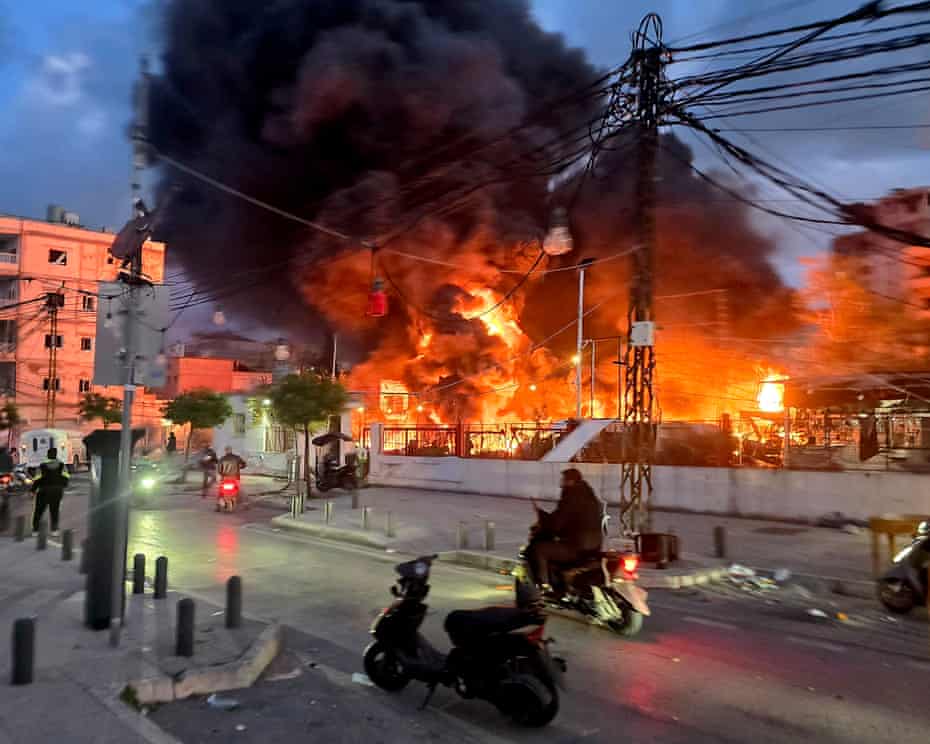
In neighbouring Lebanon, the state news agency reported several strikes, including two in southern Beirut, an area known to be a Hezbollah stronghold. Video footage showed smoke rising above the city.
Health officials said an airstrike on an apartment in the Beddawi Palestinian refugee camp near Tripoli killed at least two people and injured another.
Another strike targeted a vehicle on a road in southern Lebanon, leaving three people dead. Authorities did not confirm who carried out the attack.
Israel has not officially claimed responsibility for the latest incidents, but previous strikes in Lebanon have killed at least 75 people and forced tens of thousands to flee their homes.
Lebanon became involved in the conflict after Hezbollah, which is backed by Iran, began launching rockets into Israel. Israeli forces have since entered some border towns, triggering large-scale evacuations.
Evacuations in Qatar and Gulf Tensions
Iran has also targeted interests linked to the United States across several Gulf states, including energy infrastructure.
In Qatar, authorities announced the evacuation of residents living near the US embassy in Doha after earlier reporting that an attempted attack on Hamad International Airport had been prevented.
Residents were advised to stay indoors and avoid unnecessary travel.
Since the start of the conflict, at least 13 people—including seven civilians—have died across Gulf countries. One of the victims was an 11-year-old girl in Kuwait.
The United Arab Emirates, Saudi Arabia, and Qatar reported intercepting several Iranian missiles on Wednesday. One drone was reportedly heading toward Saudi Arabia’s major Ras Tanura oil refinery before it was destroyed.
Turkey has also been drawn into the situation after a missile launched from Iran was intercepted by NATO air defences while approaching Turkish airspace.
Turkish officials said the projectile appeared to be heading toward a British military base in Cyprus. Following the incident, Ankara summoned Iran’s ambassador and warned Tehran against actions that could further escalate the conflict.
Naval Clash Near Sri Lanka
The United States also reported sinking an Iranian warship near Sri Lanka on Wednesday. Sri Lankan authorities said they recovered 87 bodies from the sea following the attack on the IRIS Dena frigate, while more than 60 people remain missing. Another 32 sailors were rescued.
Iranian state media reported that more than 1,000 military personnel and civilians have been killed since the conflict began, although the figures could not be independently confirmed.
Iran also accused the United States of carrying out an attack on a school in the southern town of Minab on Saturday, which it said killed more than 150 people, including many children. The claim has not been independently verified, and US officials said they are investigating the reports.
The United States has confirmed that six of its soldiers have died during the conflict.
Economic Shockwaves
In Washington, the US Senate voted against a resolution that would have limited the president’s authority to continue military operations. The measure failed largely along party lines.
Even if it had passed both chambers of Congress, the president would have had the power to veto it.
The ongoing crisis is already affecting global markets. The managing director of the International Monetary Fund warned that the world could face a prolonged period of economic uncertainty.
Meanwhile, a tanker near Kuwait suffered a major explosion that caused an oil spill, according to the United Kingdom Maritime Trade Operations agency.
Several countries have begun taking precautionary economic measures. South Korea announced plans to activate a $68 billion market stabilisation fund to manage potential disruptions, while China reportedly instructed its oil refiners to suspend exports of diesel and gasoline.
China has also announced plans to send a special envoy to help mediate in the conflict, although further details have not yet been provided.

