



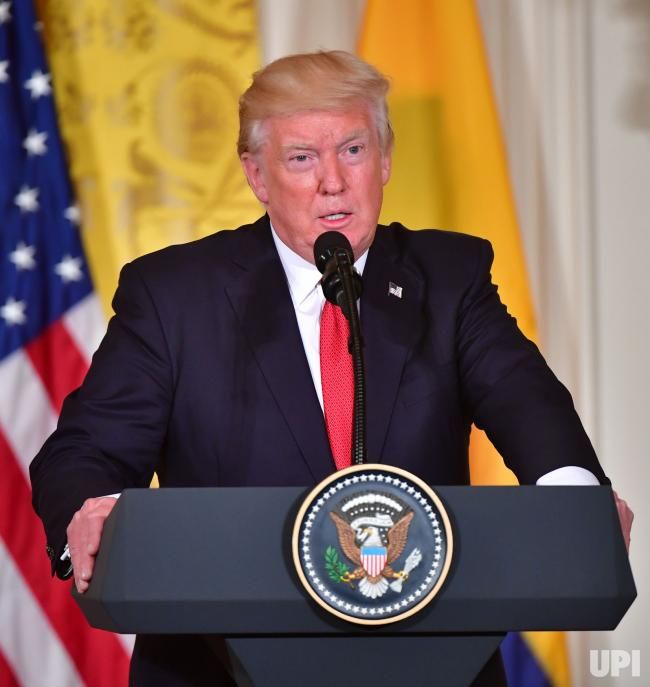
The President of the United States, Donald Trump, has stated that he believes he should play a role in determining who will become Iran’s next Supreme Leader following the death of Ali Khamenei.
Trump made the remarks during an interview with Axios on Thursday while responding to ongoing discussions within Iran about who might succeed the late leader.
According to him, some of the individuals being considered for the position are not suitable. He specifically criticised Mojtaba Khamenei, the son of the deceased leader, describing him as too weak for the role.
“They are wasting their time. Khamenei’s son is a lightweight. I have to be involved in the appointment, like what happened with Delcy in Venezuela,” Trump said.
His comment referred to Delcy Rodríguez, who rose to power in Venezuela after U.S. forces captured former president Nicolás Maduro earlier this year.
Trump also suggested that Washington would oppose any Iranian leader who continues the same policies associated with the late Khamenei.
“Khamenei’s son is unacceptable to me. We want someone who will bring harmony and peace to Iran,” he said.
The U.S. president further warned that if Iran installs a leader who follows the same political direction as Khamenei, it could lead to renewed conflict between the United States and Iran within the next five years.
Mojtaba Khamenei, a cleric believed to have strong connections with Iran’s powerful Revolutionary Guards, is widely viewed as a possible successor. However, Iranian authorities have not yet announced an official replacement.
Trump’s comments came shortly after the White House indicated that the current U.S. military operations in the region were not primarily aimed at changing Iran’s government.
In Iran, the Supreme Leader holds the highest political and religious authority, exercising significant control over the military, judiciary, and major national policies.
The uncertainty surrounding the leadership follows the death of Ali Khamenei in late February. He was reportedly killed during a series of coordinated airstrikes carried out by the United States and Israel on Iranian military and government targets.
Those strikes were part of a broader military campaign launched amid rising tensions over Iran’s regional influence and nuclear activities. Several strategic locations in Tehran and other parts of the country were reportedly hit during the attacks, escalating tensions across the Middle East.
Following the strikes, Iran responded with missile and drone attacks on Israeli and U.S.-linked targets throughout the region, raising fears of a wider regional conflict and disrupting energy shipments through the Strait of Hormuz.
Khamenei, who had ruled Iran since 1989, had not publicly identified a successor before his death. His passing has created a leadership vacuum in Tehran, prompting intense speculation about who will ultimately take over as the country’s next Supreme Leader.
- Latest
- Trending

