



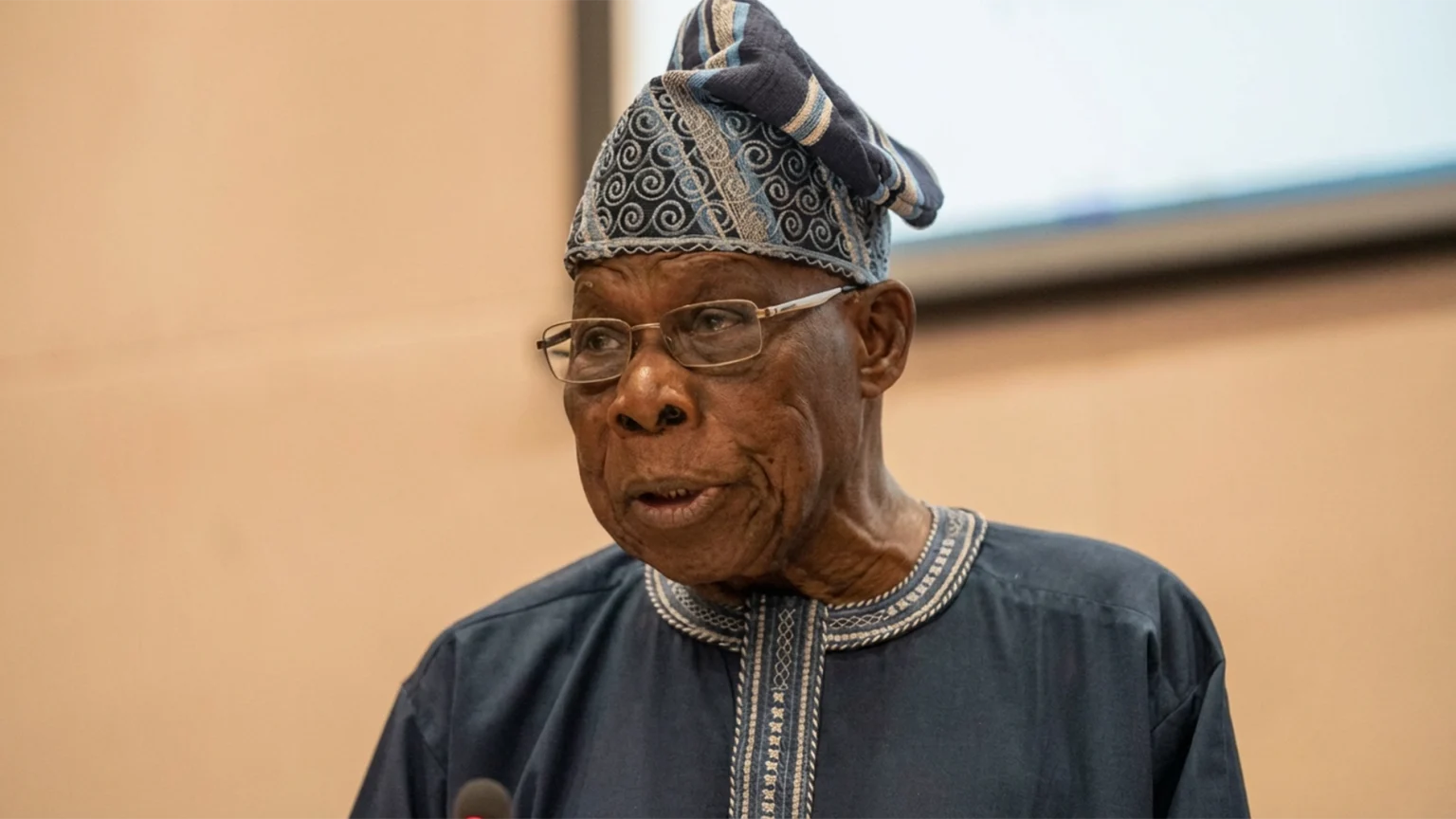
Former Nigerian President Olusegun Obasanjo has warned that Africa is experiencing one of its most difficult periods of armed conflict, violence and insecurity since independence, noting that no region on the continent is free from security challenges.
Drivetvnews gathered that Obasanjo made the observation during an interview at the Harvard Kennedy School’s Institute of Politics, monitored by SaharaReporters on Tuesday night, while discussing conflicts across Africa and efforts to restore peace.
“I think I would be right to say that since independence, because we know the period of the war of independence and things, but since independence, maybe things have not been as bad as this in terms of wars and conflicts and violence in Africa,” he said.
The former president said the situation on the continent reflected a broader deterioration in global security, noting that experts had described the current level of worldwide conflict as particularly severe.
“But Africa seems to be a reflection of the global picture because experts who are counting the number and assessing war situation all over the world have said that since the end of the Second World War, things have not been as bad as it is today,” Obasanjo said.
He added that Africa’s security situation could be viewed as part of the wider global crisis.
Describing the situation across the continent, Obasanjo said West Africa, East Africa, the Horn of Africa and Central Africa were all grappling with different forms of conflict and insecurity.
“There’s no region in Africa that hasn’t got an element of war or conflict. Africa is ridden with conflict. There’s no region which hasn’t got an element of war,” he said.
“No region without violence in one form or the other. No region without insecurity of one kind or the other. So that’s the picture that I can paint for Africa.”
Coups and Conflicts in West Africa
In West Africa, Obasanjo identified military coups in Mali, Burkina Faso and Niger Republic as developments that had affected regional stability and relations within the Economic Community of West African States (ECOWAS).
“We seem to be doing fairly well until we started having a spate of coups again. Mali, Burkina Faso, Niger Republic,” he said.
He noted that relations within ECOWAS had changed since the coups, while conflicts continued in the three countries. He added that efforts to bring them back into the regional bloc were ongoing.
Sudan and DR Congo Face Prolonged Crises
Obasanjo also highlighted the conflict in Sudan, describing it as one of the continent’s most severe humanitarian disasters.
He pointed to the involvement of external supporters in the conflict, mentioning Egypt and the United Arab Emirates (UAE) in discussing the forces backing the opposing sides.
“And then now we have the one that is worse in Sudan, where you have two parties in Sudan, one supported by Egypt, essentially, another one supported by UAE, and one of the greatest humanitarian disasters in Africa as of today,” he said.
On the Democratic Republic of Congo (DRC), the former president said the country had struggled to achieve lasting peace since 1960.
“Democratic Republic of Congo, since 1960, has not known real peace. And the worst is already developing in Democratic Republic of Congo now, with one government in Kinshasa and another government building up in Goma, eastern Congo,” he said.
He added that tensions between Rwanda and the DRC had persisted for more than three decades.
Obasanjo Calls for Understanding of Conflicts’ Root Causes
The former president also discussed Ethiopia, where a peace agreement had helped halt major fighting for more than three years, although tensions had resurfaced.
Obasanjo argued that resolving conflicts required a clear understanding of their underlying causes and the involvement of the parties directly concerned.
“It’s not by the mediator. That’s the first thing. Another thing that must be realized is that we must understand the underlying factors,” he said.
He further called for international assistance where necessary, stressing that the principle of “African solutions to African problems” should not prevent African countries and institutions from seeking support from partners outside the continent.
According to him, the appropriate approach should depend on the nature of each crisis and whether it could be addressed through bilateral discussions, regional cooperation, continental institutions or international assistance.

