



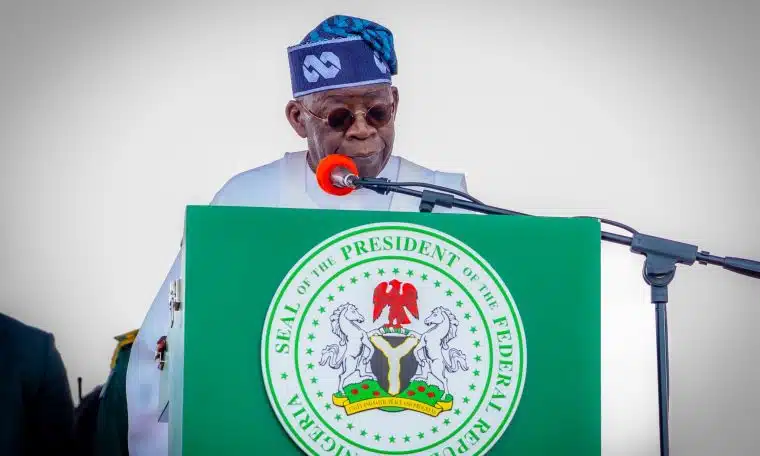
President Bola Tinubu has declared that Nigeria has moved beyond the most difficult phase of his economic reforms, saying the country is now entering what he described as an “age of prosperity.”
Drivetvnews gathered that Tinubu made the declaration in his Independence Day address to Nigerians on Thursday as the country marked its 66th anniversary.
Speaking under the theme, “From Reform to Prosperity,” the President defended key policies introduced by his administration, including the removal of petrol subsidy and the unification of the foreign exchange market.
Tinubu compared the country’s previous economic situation to a patient diagnosed with a serious illness who must choose between undergoing painful treatment or relying on temporary relief while the underlying problem worsens.
He argued that previous administrations had postponed difficult decisions, while his government chose to confront the structural challenges facing the economy.
The President also criticised calls for the return of petrol subsidies ahead of the 2027 general election, describing such proposals as a distraction from the reforms already implemented.
He urged Nigerians to remember the reasons behind the reforms and resist attempts to reverse them.
Tinubu said his administration’s policies did not create Nigeria’s economic weaknesses but were introduced to address problems that had accumulated over time.
According to him, the economy grew by more than four per cent in 2026, with both the oil and non-oil sectors contributing to the growth.
He also said oil theft had declined, inflation had dropped from its previous peak, foreign reserves had improved and the foreign exchange market had become more stable.
Tinubu further disclosed that Nigeria recorded its highest-ever non-oil export revenue in 2025, exceeding $6bn.
The President said the focus of his administration had now shifted from correcting the country’s economic direction to delivering broad-based prosperity for Nigerians.
He said the next phase would focus on improving the lives of ordinary citizens, including farmers, manufacturers, entrepreneurs, workers and families struggling with the cost of living.
On reducing living costs, Tinubu said the government would focus on lowering the cost of producing and transporting goods.
He listed plans to expand irrigation and dry-season farming, improve access to seeds and fertilisers, increase agricultural mechanisation and strengthen storage and transportation infrastructure.
The President also promised further investment in roads, railways and ports to improve connections between farms, factories and markets.
Tinubu said his administration would place job creation, enterprise development and industrial growth at the centre of its next phase.
He promised to promote the use of domestic gas to power industries, revive factories in industrial centres, expand digital connectivity and provide young Nigerians with skills relevant to the labour market.
On poverty and social welfare, the President said the government was strengthening direct assistance to vulnerable households and improving the National Social Register to ensure support reaches those who need it.
He also highlighted the Nigerian Education Loan Fund, NELFUND, and the Consumer Credit Corporation, CREDICORP, as programmes designed to expand access to education and consumer financing.
Tinubu said salaries and pensions had been paid on time since 2023 and that reforms in the pension system were intended to improve support for retirees and vulnerable Nigerians.
He acknowledged that welfare programmes could not replace broad economic prosperity, describing them as temporary bridges towards a stronger economy.
Concluding his address, Tinubu used the biblical account of the Israelites’ exodus from Egypt as a metaphor for Nigeria’s economic journey.
He said the country had passed through its own difficult period and urged Nigerians to look forward rather than return to the past.
The President’s address came amid continued concerns over the cost of living and growing political debate ahead of the 2027 general election, with fuel subsidy policy remaining one of the issues being debated by the ruling party and opposition political actors.

